
Things that don't exist
His first phone, the Beetle 1, presented a standard touchscreen at the front, but this was in fact the phone’s belly, and the back was the convex carapace of a beetle.

A New Handbook on Ancient Automata was published in 1959, bring attention to the much-ignored history of ancient robotics. Automata have been used as parables of modernity: the Mechanical Turk, de Vaucanson’s Digesting Duck, the Jaquet-Droz Trio. This conceals their true first breath, which took place millennia ago. The automata of the 18th century represent the field’s adolescence, not its birth. The greatest impediment to automatic life is the concept of purpose. In the 19th century, when it was realised that machines could be used for good reasons, animatronics experienced a little death. The automata of the 18th century existed solely as a form of aristocratic wastefulness, and in this regard are best compared to the automata of ancient times.
You might already know that ancient people did not accumulate scientific knowledge for any particular purpose. The application of knowledge towards either productive means or experimentation was considered base and uncivilised. Upon figuring out some tricksy mechanism or law of nature, ancient men of leisure would employ it only as a novelty or amusement. So, it should be no surprise that the pinnacle of the ancient mechanical arts lay not in cranes, washing machines, or factories, but in the construction of useless automata. Automata are described throughout mythology and literature. The statues of Daedalus were said to move around rapidly, propelled by some god-given mechanism — perhaps either running on their legs or racing on wheels, with their faces unchanging. Alcinous’ palace was guarded by golden and silver watchdogs, and his great palatial doors laden with gold opened for visitors by some automatic mechanism. An inventor in ancient Zhou, Yan Shi, created an artificial man to present to the emperor, who moved and spoke as if alive. The emperor demanded the artificial man be cut up se he could see its inner workings, only to find the artificial man was full of organs. Of course, we know of further attestable ancient robotics — the Antikythera mechanism, the very first cuckoo clocks, and on Rhodes, where there was a particularly strong tradition of mechanical engineering, we hear from Pindar:
The animated figures stand
Adorning every public street
And seem to breathe in stone, or
move their marble feet.
Put simply, it is clear that automata widely populated the ancient world. A New Handbook on Ancient Automata argues that we must reconsider our picture of antiquity. We conflate the ancient with the fantastical and primordial, such that we are loathe to insert robots into this pretty picture. But all evidence is to the contrary. Robotics were a staple in ancient life. They fill the annals of poetry and histories, and just as you would see nowadays in any tourist city, the carts of amusement vendors were full of little mechanical jokes. Consider little wooden birds filled with air. You admire their painted bellies and shoot them up into the sky, then watch them land some distance away. Odd little collections of metal legs, arranged to catch the wind and race forward. little dogs who yap and whine when wound up, with big drooping heads and floppy ears sewed on to their metal chassis. Performing statuettes, plucking internal strings to sing preprogrammed songs. Bronze flowers which bloom when exposed to sunlight.1
A New Handbook on Ancient Automata received mixed reviews upon first release. One reviewer called it “that infrequent triumph of scholarship — neither a moribund restatement of all that has been said, nor a work that says whatever seems to be true, but a book whose pronouncements are both novel and plausible, inventive and well-argued.” Another reviewer called it a “headsplitter”.
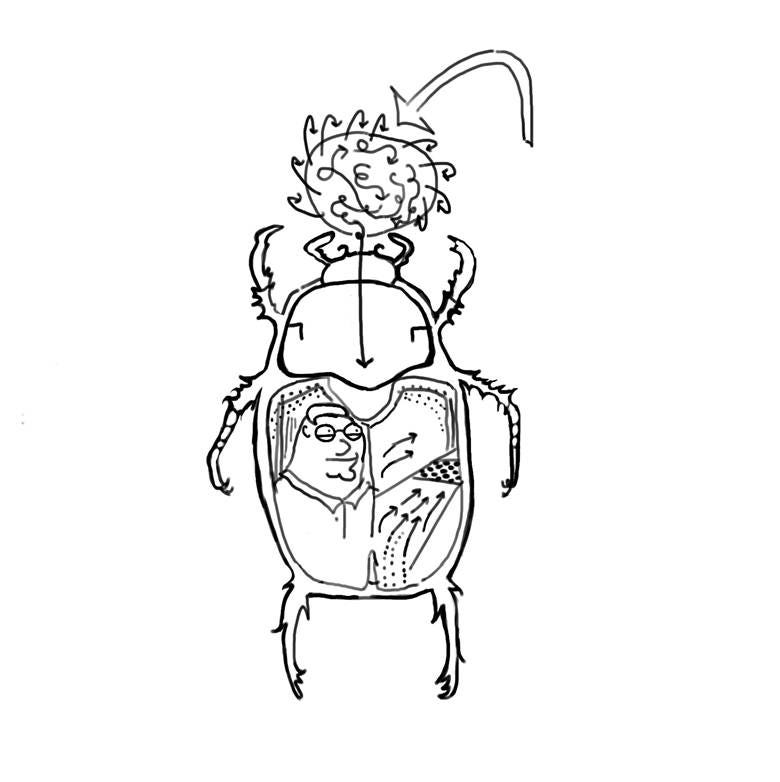
The Rockphone was part of the new naturalist turn in consumer technology, a movement best compared to the birth of Romanticism at the turn of the 19th century. With the iPhone 20, Apple had designed a phone which, other than its camera, was infinitely slim, only a few nanometres deep, so it couldn’t be seen from the side and was easily lost when laid down on a flat surface. Attempting to go even further beyond, Apple began work on new two-dimensional phone technology. The only way phones could get slimmer was by becoming pure representation. Apple’s new phone, the iPhone 21, was a disaster that nearly killed the company, since it was a printed image of a phone which could not be used in any meaningful sense. This disaster, however, ushered in an era of genius under new Chief Design Officer Rich Rockfort.
Rockfort revolutionised Apple’s design philosophy with a series of naturalistic phone designs. His first phone, the Beetle 1, presented a standard touchscreen at the front, but this was in fact the phone’s belly, and the back was the convex carapace of a beetle. To turn the phone on one had to jumpstart it with a firm flick, as you would give to a pen nearly out of ink. At this, the beetle’s wings would explode outward, and the device began fluttering and chuffing to life in your hands. The device’s charging port was entirely novel. Rockfort found it objectionable that all prior phones were charged from the bottom. He called this an intolerable deviance from natural life. The Beetle 1 was charged from the top. An adapted USB-C charger was fitted to the mandibles of the beast, and a thick nutrient paste was deposited straight into its beetle mouth. All waste was given off as heat and screentime, and if the Beetle 1 was overcharged, it might turn itself on and fly around to expel some energy while playing YouTube Shorts on repeat.
