
Can you solve my riddles three?
How to appreciate riddles, and how I started writing them

I have recently taken pleasure in riddles and the art of riddlemaking. Riddles are an ancient form, with their greatest expressions found in antiquity & the mediaeval era. They are found both as stand-alone puzzles (often compiled in collections like the Palatine Anthology) and as individual elements in broader texts. First, I will give a number of examples from antiquity to sketch out their role.
King Solomon of Judaea and Hiram of Tyre (in the Bible, it is Solomon & Queen Sheba) exchanged riddles as a sort of associative correspondence chess, and in fact wagered the wealth of their respective kingdoms on this riddle exchange, so that each kingdom became rich in accordance with the wisdom of its king. At first, Hiram was utterly unable to solve Solomon’s riddles, and his kingdom was nearly bankrupted. Hiram fired off with his own riddles, however, and by beating Solomon at his own game, the wealth of the two kingdoms was equalised. The astute reader will notice that the famous quandary posed to Solomon in the Bible, of dividing a baby between two women who claimed to be its mother, takes the form of a practical riddle.
Oedipus solves a famous prototypical riddle1 to save the city of Thebes from the clutches of the Sphinx, itself representative of the intrinsic structure of mystery (a human visage at front concealing an unexpected beastly nature round the back). In solving the riddle Oedipus demonstrates his acute ability to penetrate via intellect the obscure nature of things. Because of this, he is made king of Thebes. The riddle becomes representative of the tragedy of his life — the answer for his life’s troubles is himself, the ‘man’ who is the subject and solution of the riddle, and his penetrative abilities reveal the beastly self at play in his own life story.
Alexander was presented with an infamous puzzle as a test of his genius: the Gordian knot, which was un-untiable. Knots are a practical test of skilfulness, but have a theoretic aspect, being solved by the application of topological thinking. Demonstrating unique practical acuity, talent in violence, and a theoretic mind which approaches problems by tackling them in a higher dimension (outside the box thinking), Alexander cuts through the knot with his sword.
Riddles continue to feature throughout ancient literature and cross over multiple disciplines. The modern mathematical ‘word problem’, a staple of pedagogy, has its origin in the Hellenistic mathematical epigram. With particular literary flair questions are posed through miniaturised tragedies, laments, epitaphs, and other sorts of narratives. Here is an example, the Epitaph of Diophantus the mathematician:
“This tomb holds Diophantus. Ah, what a marvel! And the stone tells scientifically the measure of his life. God granted him to be a boy for the sixth part of his life, and adding a twelfth part to this, he clothed his cheeks with down; He lit him the light of marriage after a seventh part, and five years after his marriage He granted him a son. Alas! dear child of late birth; after attaining the measure of half his father’s life, chill Fate took him. After consoling his grief by this science of numbers for four years he ended his life.”
In this example, a fractions problem is given as a funerary epitaph, combining mathematical and literary forms. The problem divides the span of a human life into fractions, including the poignant detail of a son who lived for ½ the life of his father.
This should serve to acquaint the reader with ancient riddles. Riddles, I have noticed, are an underutilised form in the modern day, mostly relegated to parodic depictions (“what is the air-speed velocity of an unladen swallow?”) We underutilise riddles for a few reasons. Other, more direct puzzle forms have overtaken them (crosswords, sudokus, wordles). I’d also argue that riddles are antithetical to short form thinking and thus tend to frustrate the modern puzzler. Modern puzzles (even cryptics) tend to involve direct, instantaneous manoeuvres, executed one after another, to bring one to a conclusion. Riddles, as we have seen, can form part of lengthy correspondences, and can become representative of one’s entire life. A good riddle can lead you on a contemplative journey, lasting hours, even days or weeks. The puzzler is led through a variety of associations artfully laid out by the riddlemaster — the decision to regard a certain word as either literal or figurative, for example, can conjure up a whole train of fun images. Here’s a classic example given to me by a friend of mine:
“There is a house. One enters it blind and comes out seeing. What is it?”
If you’d like to solve it yourself, skip to the next paragraph. My first thought was to give various places that might cure blindness, e.g. a hospital, but this was incorrect. I considered a change in time, so that night becomes day, illuminating the blind man. Since I was still wrong, I realised at least one element must be metaphorical. A house could be metaphorical for life, so perhaps a dead blind man begins to see in Heaven, but this wasn’t it either. So the metaphorical element must be blindness. Knowledge = enlightenment being perhaps the most ancient figurative association there is, I answered that the ‘blind’ man had entered a school, and emerged enlightened, which was correct.
This riddle kick started quite recently, when I was recently copyediting a new series of maths textbooks for work. One each page a riddle, aphorism, or motivational quote is included as flavor text. One particular example stuck with me:
“Every multiple of 9 eventually confesses.”
“Every” must make this an axiomatic rule, and “eventually” must be a cryptic signifier for “after performing some operation”. So, the aphorism tells us that multiples of 9 are always revealed through some simple manouevre. I realised this was referring to the concept of a digital root, and the rule of 9, whereby the digital root of any multiple of 9 is 9 (18, 1 + 8 = 9; 27, 2 + 7 = 0, etc.) I found this little piece quite adorable, and set out to compose some riddles myself.
Riddle-making, I have found, has commonalities with poetry composition & short story writing, particularly in relation to my own process. The writer begins by finding pleasing associations, each of which usually comes with additional associations, homonyms, homophones, alternate wordings, and logical consequences. The writer can indulge in or excise each one respectively, creating a layered web of associations, drawing the recipient audience down a fine-crafted geometry of thought-images, as if creating for them a free-standing labyrinth or dungeon.
The great pleasure, however, comes in the personal element of delivering a riddle to those worthy. For one, you get to LARP as a wise old sage, or as the Riddler, and test the abilities of your friends & associates. You also find that everyone solves riddles in their own way: some get to the answer instantly, as if by magic, demonstrating a Gordian knot sensibility; others become easily frustrated and are unable to bear it, asking for hints to draw them out of the quagmire of genuine mental tension; others love letting riddles sit, enjoying the associative journey created, turning over each element and gradually adjusting their assumptions to reckon with the hidden meaning you present them with. The writer or artist, too, must deal with all these kinds of psychology.
I am reminded also of the Glass Bead Game in Hesse’s titular novel. A community of ascetic scholar-monks dedicate themselves to the solemnest of intellectual & spiritual pursuits, living a pure life of the mind away from the outside world. Their highest art is not the commentary or treatise, but a game, in which players are tasked with associatively responding to concepts posed by their interlocutors. In response to a certain thought-image, one might respond competitively, or constructively, or with some other incredible manoeuvre, as if maintaining a tennis rally. Essentially, the game is intellectual riffing: the rules are unclear, but there are respected conversational conventions which one might play with, and particularly beautiful games have a lasting impact on the mind.
This has something in common with the esoteric ‘Great Conversation’, the concealment of meaning as in Strauss, and with artistic creation and good conversation generally. All, in short, add up to make the riddle, and I am quite eager to pursue riddle-making as a discipline further. Having composed a few riddles while hungover at work, I posed them to friends whose intellect I respected, and took a great deal of pleasure in watching their minds work. It was a purer, more rarefied version of the pleasure I get in sharing my writing with others. In my writing, I get to craft my web of associations, and I receive pleasure when my work is read, when it is praised, and in particular when it is analysed and responded to. Thinking of literature, the writings of Kafka, which are not mere surrealism, draw heavily on the concept of the riddle (see the parable of the man before the law), and in my own writing I often encode ‘solutions’ which readers might grasp.
A difference between the riddle and the novel or short story is that stories tend to hold many meanings, without the simplicity of a direct allegory, whereas riddles, even when taking the puzzler on a complex journey, have only one solution. But invoking again the prior mathematical example:
“This tomb holds Diophantus. Ah, what a marvel! And the stone tells scientifically the measure of his life. God granted him to be a boy for the sixth part of his life, and adding a twelfth part to this, he clothed his cheeks with down; He lit him the light of marriage after a seventh part, and five years after his marriage He granted him a son. Alas! dear child of late birth; after attaining the measure of half his father’s life, chill Fate took him. After consoling his grief by this science of numbers for four years he ended his life.”
The process of solving the mathematical problem exists separately to and in equal measure with the portrayal of a pleasing image. Solving the fractions problem does not in itself add to the image of the dead man, his life divided into fractions, his son with half the lifespan of his father. But the process of solving the text provides friction, causing one to linger longer in the space of the image. I believe Nabokov often has something like this in mind.
Putting further commentary aside, I will conclude with some words for the reader: apologies for my infrequent publications as of late, once out of the habit of weekly releases, it is quite hard to slide back in, and I have been engaged with both novel-writing and the coming commencement of my masters course (I will be researching ancient mathematical riddles further, among other topics). For the reader, I also leave the three riddles I created in one go recently, which I gave out to some friends. I encourage people to come forth with their answers. For any correct solutions, I will gift discounted paid subscriptions. Here are the riddles:
“What ties things together and makes them nonexistent, requiring deft hands?”
“I was around long before Homer, a metres-long winged dancer. I took my steps on webbed feet. What am I?”
“I was born incapable
My caretaker keeps me in bed
Friends of my ilk have been loved for millennia
What am I?”
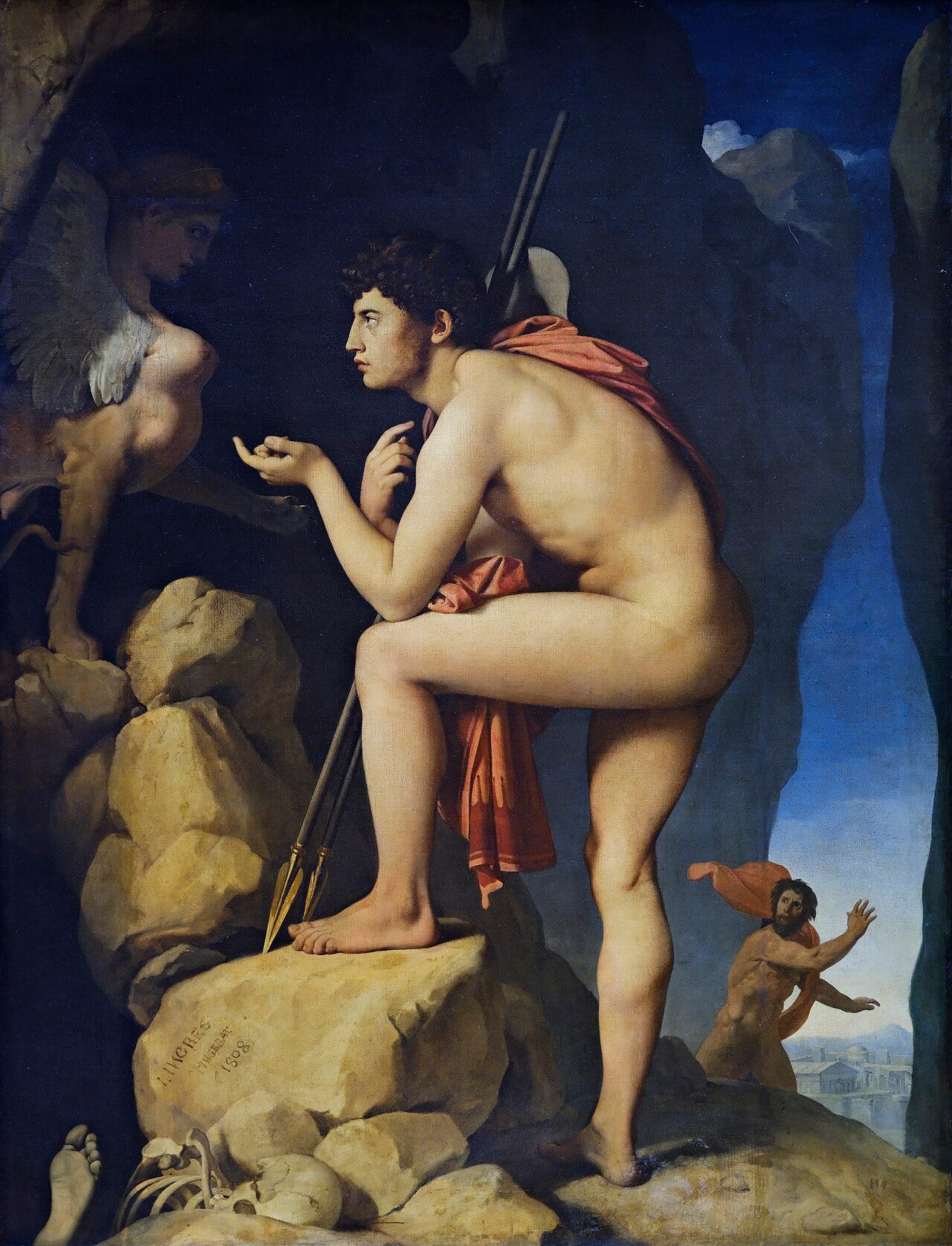
“What goes on four legs in the morning, two legs in the afternoon, and three legs in the evening?”
Is the third one the silkworm?
Rare substack appearance for Betteridge's law